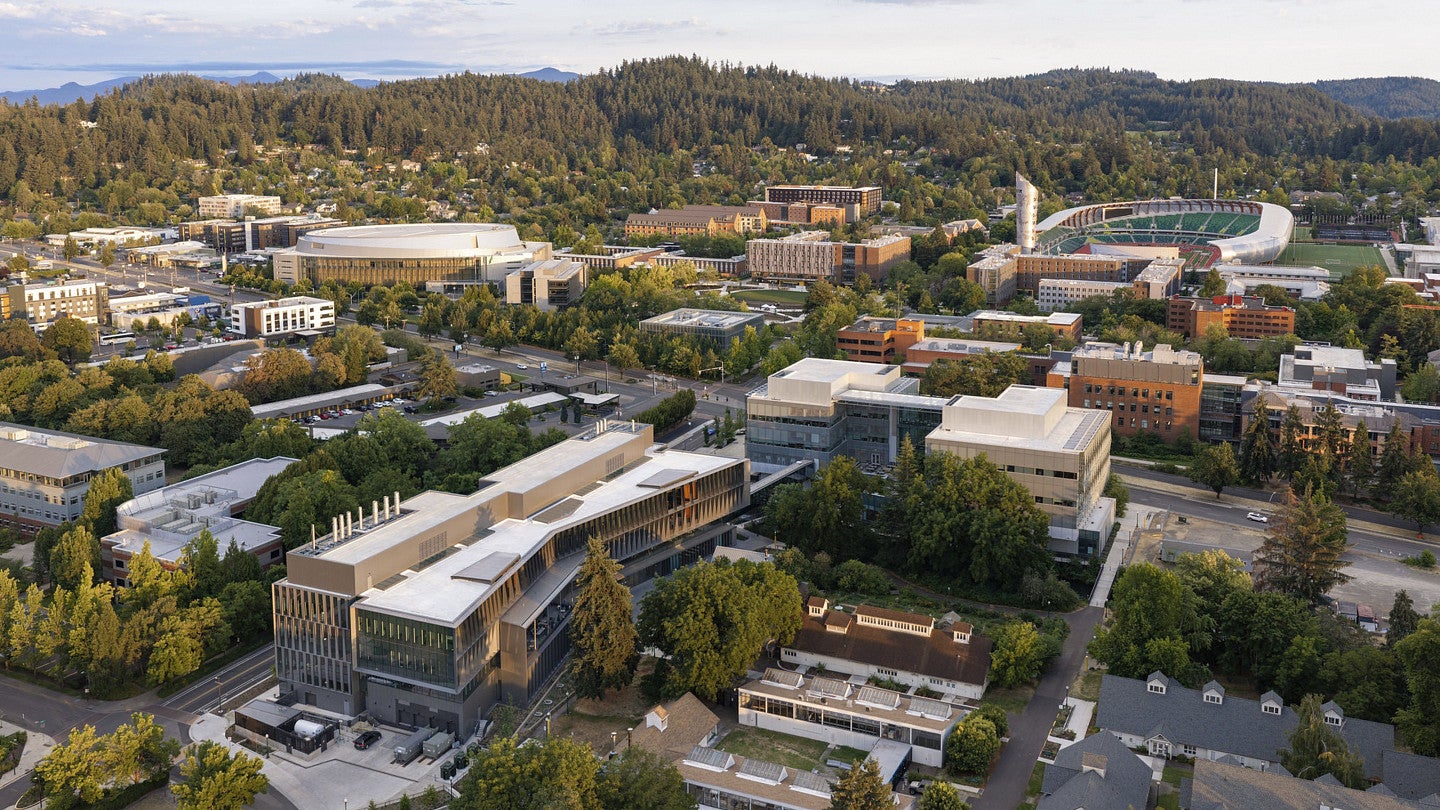
At the Phil and Penny Knight Campus for Accelerating Scientific Impact, they’ve got trash covered. Literally. Attractive metal plates now sit over garbage chutes throughout the research campus, courtesy of a nifty collaboration between custodian Judy Haines and the facility’s technical teams.
The Knight Campus Brewing Innovation (BRIN) program will host a public tasting and showcase on Tuesday, Dec. 9, 5–8 p.m. at Claim 52 (upstairs) in Eugene. The event celebrates the inaugural cohort of BRIN students and highlights three imaginative, student-designed beers brewed in collaboration with Eugene’s craft community.
The University of Oregon team based at the Phil and Penny Knight Campus for Accelerating Scientific Impact earned a Gold Medal at the 2025 iGEM Grand Jamboree in Paris, becoming the first UO team ever to achieve the top award level in the international synthetic-biology competition.
During uncertain times, resiliency and bold ideas can still thrive. In a letter to the KCGIP community, Assistant Vice President for Master’s Programs Stacey Wagner envisions a meaningful path forward.
Researchers from the Phil and Penny Knight Campus for Accelerating Scientific Impact participated in the Cascadia Corridor Research Symposium in Seattle, highlighting the range of research taking place across the Knight Campus.
Three Knight Campus–affiliated startups earned top recognition at the Oregon Bio 2025 Conference and Innovation Showcase, held at Portland Community College’s Rock Creek Campus.
The award from the International Foundation for Ethical Research (IFER) will further the bioengineering PhD candidate's research on cartilage development.
Faculty from the University of Oregon and Oregon State University Departments of Bioengineering will host an informal conversation about research, resources, and funding opportunities on Tuesday, October 28, 2025, from 2–3 p.m. PT.
Penderia Technologies, a spinout of research within the Phil and Penny Knight Campus for Accelerating Scientific Impact, is moving closer to its vision of improving medical care by relaying information from deep inside a patient to support care during and after surgery.