
Research in the Bredenberg Lab
It remains a puzzle how the brain builds sensory representations and learns complex tasks so effectively, even though each of its trillions of synapses adjusts itself with only limited information about what's happening elsewhere in the brain. We think machine learning could help us solve this mystery, because it can connect small-scale synaptic changes to large-scale learning outcomes through mathematical principles. Work in our lab revolves around creating, improving and testing theoretical models inspired by machine learning to help us understand the computational mechanisms of learning in the brain.
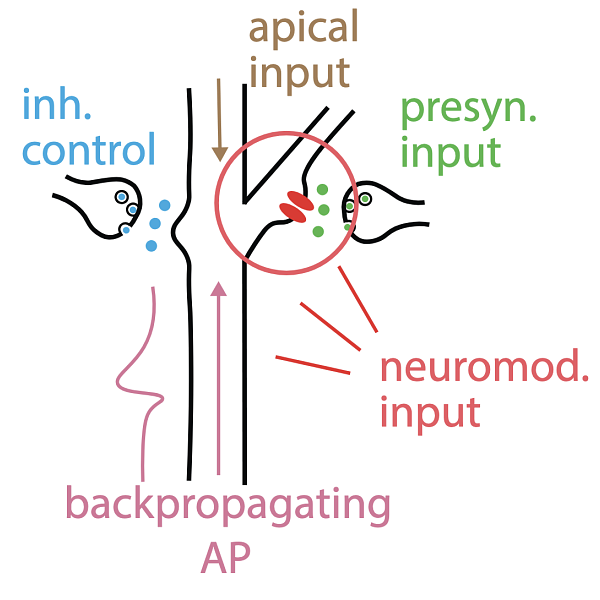
While many models exist that seek to describe how the brain could learn to build sensory representations or learn from reinforcement using synaptic plasticity, most of these models do not perform nearly as well as state-of-the-art machine learning methods.
We are working to improve the performance and realism of biological learning models by building neural network architectures that synergize effectively with models of low-level cortical information processing and synaptic plasticity.
In recent years, numerous statistical tools have been developed to jointly characterize neural representations and behavior in terms of low-dimensional manifolds and dynamics; however, there is a comparative absence of similar techniques that describe learning-induced changes in the brain.
Our lab is working to create approaches to statistically quantify learning in neural representations and behavior.
To do this, we will collaborate with experimental neuroscientists to develop novel statistical methods to characterize the neural basis of learning in naturalistic environments, using a spectrum of approaches, from simple, interpretable methods to powerful deep learning-driven decoding approaches..
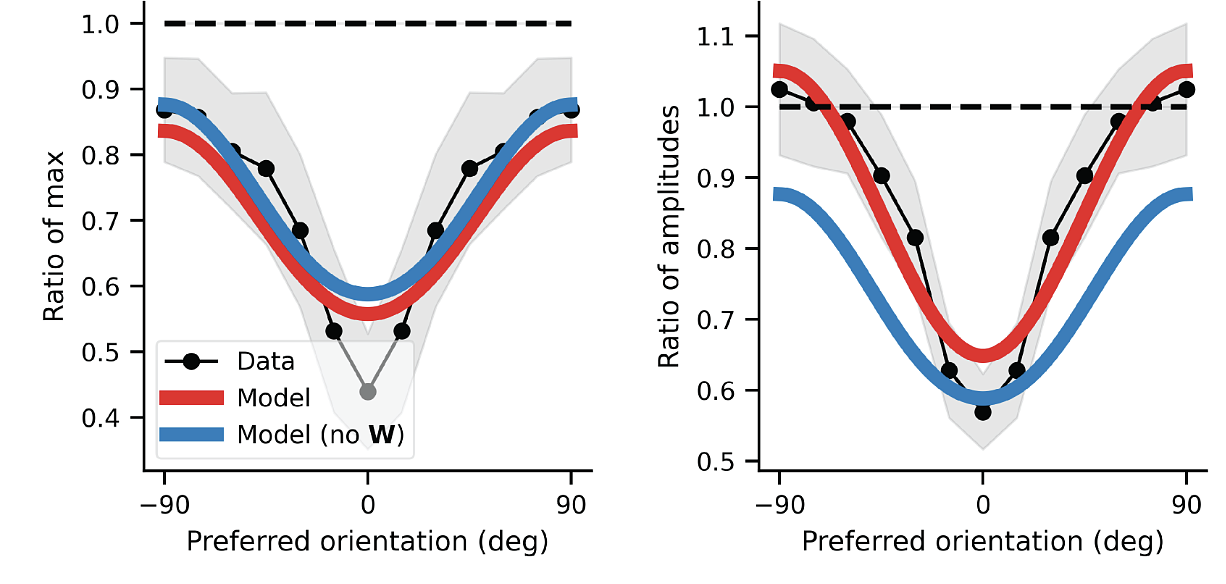
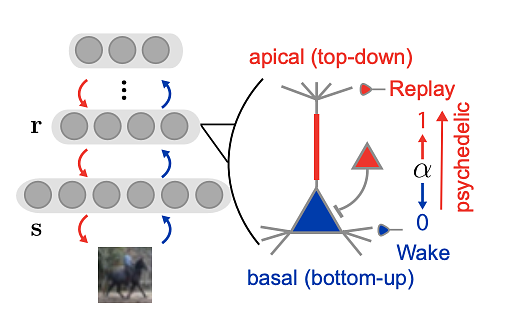
We are collaborating with experimental neuroscientists to test different learning theories in clinically relevant contexts. To do this, we have a collaboration with the Allen Institute for Brain Science to test candidate models for how mice learn to control brain-computer interfaces (BCIs). We are also collaborating with experimental neuroscientists to investigate whether shared neural mechanisms underly both classical psychedelic-induced hallucinations and sleep-dependent memory consolidation.
Collaborators

The Allen Institute
The Murray Lab
Mila – Quebec Artificial Intelligence Institute
Featured Publications

2026
Modeling the hallucinatory effects of classical psychedelics in terms of replay-dependent plasticity mechanisms
eLife
2024
Recurrent Neural Circuits Overcome Partial Inactivation by Compensation and Re-learning
Journal of Neuroscience