Peptides are small stretches of amino acids (<40 residues) that can be made out of non-canonical building blocks. Many naturally occurring peptides are involved in self-defense and signaling. Their small size, stability, and ease of synthesis make them attractive as therapeutics.
Modeling peptide behavior in solution
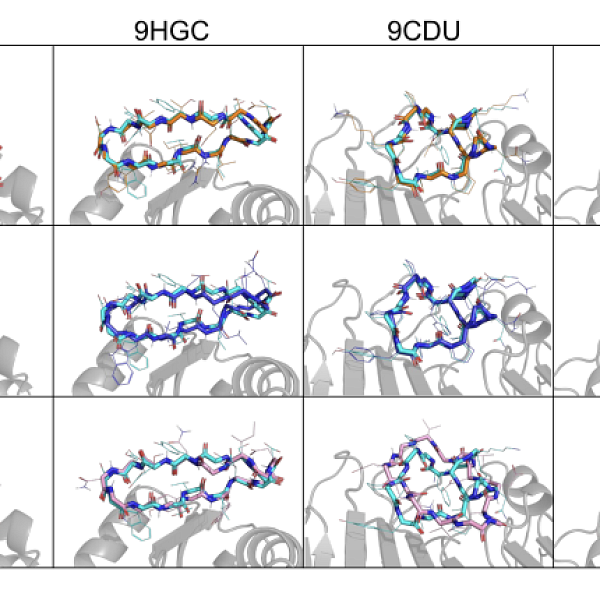
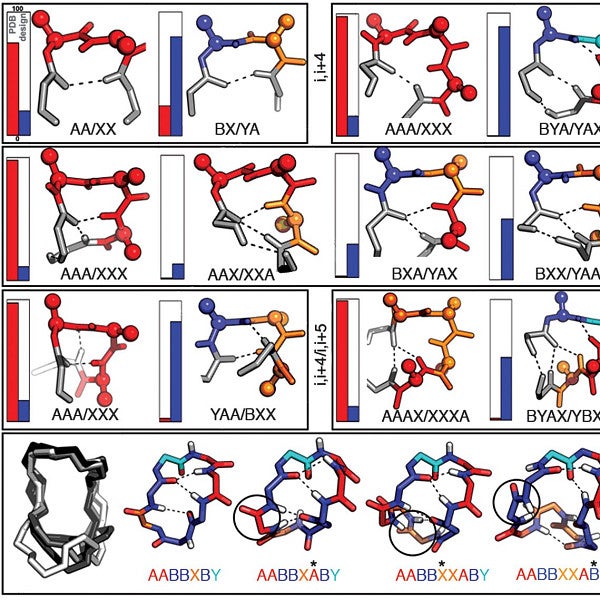
We sample the conformational landscape of peptides using a combination of Rosetta-based backbone sampling, molecular dynamics simulations, and machine learning. Combined with large experimental data, we are generating insight into what contributes to a peptide's ability to cross the cell membrane — and whether permeability differs between mammalian and bacterial cells.
Designing peptide-based binders
We develop computational methods to design peptides that bind selectively and strongly to targets of interest, including viral intra- and extracellular targets and GPCRs.
Novel Functional Proteins
Proteins perform most of the essential functions that sustain life. Our lab uses computational and experimental approaches to design novel functional molecules.
New enzymes
We combine Rosetta, sequence-based learning, and generative methods with high-throughput experimental data to understand what drives successful enzyme design — then use that knowledge to design enzymes catalyzing novel reactions.
Selective biosensors
Computationally designed proteins and peptides serve as sensing modules in biosensors. Their stability enables diagnostics without cold-chain transport. Current focus: MMP family enzymes as biomarkers of pre-inflammatory gum disease.
Protein binders as delivery molecules
We develop computational methods to design peptides that bind selectively and strongly to targets of interest, including viral intra- and extracellular targets and GPCRs.
Protein Design
The function of our cells is regulated through a complex network of protein-protein interactions (PPIs). Hub proteins — which interact with multiple partners — are central to biological regulation and frequently implicated in disease. Our lab uses computational protein design to selectively target individual PPIs.
Targeting binding through disorder-to-order transition
Many hub proteins accomplish promiscuous binding through disordered regions that undergo a disorder-to-order transition upon binding. Using protein design, we selectively stabilize the ordered binding motif to inhibit only one partner — producing small, genetically encodable binders as tools to study the cellular effects of each interaction.
Funding and Support
Thanks to these organizations for funding our research
The Donald E. & Delia B. Baxter Foundation
NIH Director's New Innovator Award
DARPA
National Science Foundation
Rosetta Commons Mini-Grant
University of Oregon
Knight Campus
Featured Publications
2026
Peptide Permeability Measurements in PAMPA: Sources of Variability and Implications for Data Reproducibility
Founded in 2020, the Parisa H. lab is a protein engineering research group within the University of Oregon's Phil and Penny Knight Campus for Accelerating Scientific Impact. Based in the Department of Bioengineering in Eugene, Oregon, the Parisa H. lab designs novel peptides and proteins that tackle some of the challenges of 21st century.