
Current research projects
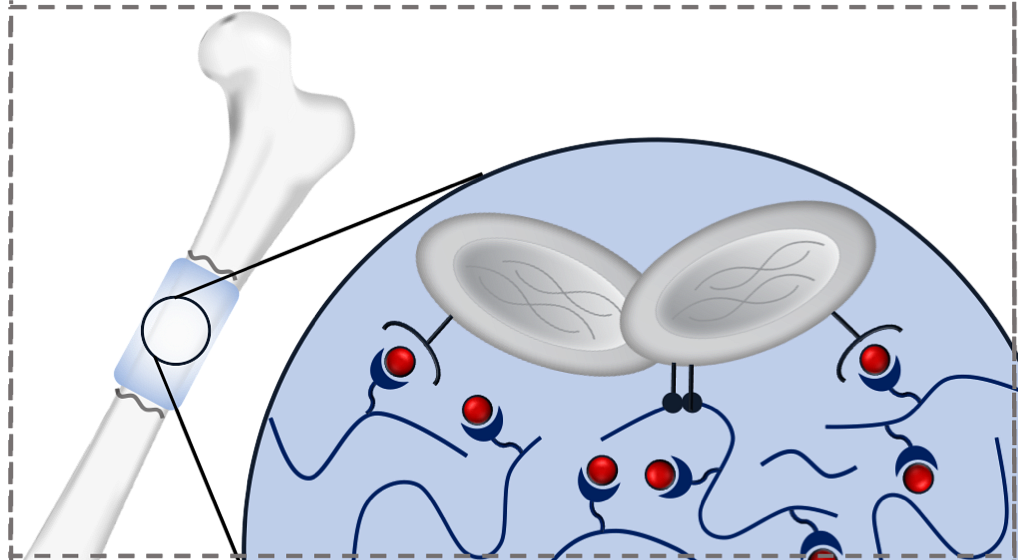
In the past, our lab has developed affinity-based biomaterials for protein and cell delivery to large bone defects and the stroke-injured brain. Currently, we're using new techniques in protein engineering and computational modeling to design more effective biomaterials for protein delivery.

Current strategies for controlling protein delivery from biomaterials rely on natural protein-material interactions with limited tunability or the expression of challenging fusion proteins.
We are using a combination of computational protein modeling and display platforms to generate specific affinity interactions with proteins of interest, such that their local presentation and effect on different stages of tissue healing may be tuned with precision and flexibility.
This approach will enable the controlled delivery of multiple therapeutics from a single biomaterial delivery vehicle.
Stem cell transplantation can stimulate tissue repair through the secretion of pro-regenerative paracrine factors. Harnessing the regenerative and immunomodulatory potential of stem cells through their secretome represents a recent paradigm shift in the field of tissue engineering.
We are creating biomaterial delivery vehicles that facilitate both paracrine- and cell-based tissue repair strategies by (1) presenting biochemical cues that promote cell viability and encourage paracine factor secretion of stem cells, and (2) selectively sequestering paracrine factors in the injury micro-environment using affinity-based biomaterials.
We aim to prolong local presentation of secreted proteins beyond the initial period of transplanted cell survival and create a pro-regenerative environment within injury sites.
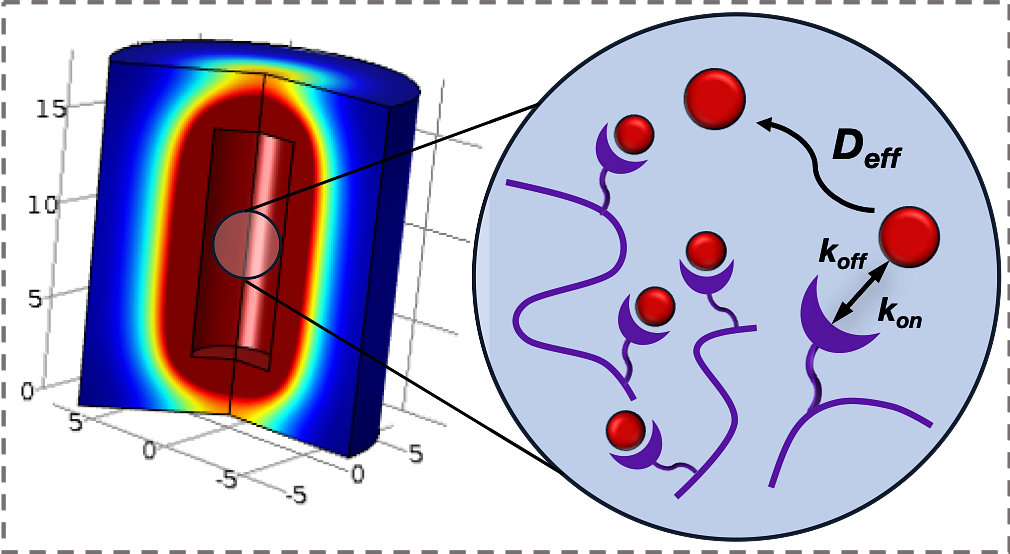
A major challenge in developing biomaterials for sustained protein delivery is the difficulty of recapitulating the dynamic cellular and molecular makeup of the injury environment in the lab.
Many biomaterials that provide sustained delivery in vitro exhibit rapid protein release in vivo due to cellular uptake, competitive protein binding, and changes in tissue diffusivity.
We are developing computational models that better capture the dynamic healing environment and can more accurately predict protein release in vivo, allowing us to design better biomaterials for in vivo protein delivery.
Funding Sources
We are grateful for funding from the Wu Tsai Human Performance Alliance, National Institutes of Health, National Science Foundation, Department of Defense, and the Donald E. and Belia B. Baxter Foundation.

The Wu Tsai Human Performance Alliance

National Institutes of Health (NIH)

National Science Foundation (NSF)

The US Department of Defense

Donald E. and Belia B. Baxter Foundation
Hettiaratchi Lab Publications

2026
Phased affinity-controlled delivery of vascular endothelial growth factor, fibroblast growth factor-2, and platelet derived growth factor enhances in vitro angiogenesis
Journal of Controlled Release
2025
Hyaluronic Acid-Coated Melt Electrowritten Scaffolds Promote Myoblast Attachment, Alignment, and Differentiation
Cellular and Molecular Bioengineering
2025
Applying Computational Protein Design to Engineer Affibodies for Affinity-controlled Delivery of Vascular Endothelial Growth Factor and Platelet-Derived Growth Factor
Biomacromolecules
2024
An Expanded Palette of Fluorescent COS/H2S-Releasing Donors for H2S Delivery, Detection, and In Vivo Application
Angewandte Chemie International
2024
Biomaterial Strategies for Regulating the Neuroinflammatory Response
Materials Advance
2024
Statistical Optimization of Hydrazone-Crosslinked Hyaluronic Acid Hydrogels for Protein Delivery
Journal of Materials Chemistry B
2023
Moderate-Affinity Affibodies Modulate the Delivery and Bioactivity of Bone Morphogenetic Protein-2
Advanced Healthcare Materials
2022
Directed Evolution Enables Simultaneous Controlled Release of Multiple Therapeutic Proteins from Biopolymer-Based Hydrogels
Advanced Materials
2022
Reactive Sulfur and Selenium Species in the Regulation of Bone Homeostasis
Free Radical Biology and Medicine
2021
Directed Evolution Enables Simultaneous Controlled Release of Multiple Therapeutic Proteins from Biopolymer-Based Hydrogels
Biomaterials Science
2020
Heparin-Mediated Delivery of Bone Morphogenetic Protein-2 Improves Spatial Localization of Bone Regeneration
Science Advances
2020
Re-engineering Biocatalysts: Computational Redesign of Chondroitinase ABC Improves Efficacy and Stability
Science Advances
View All Hettiaratchi Lab Publications
Current Hettiaratchi Lab Pre-Prints
▼
Discovery and Characterization of Interleukin-4-Specific Affibodies for Affinity-Controlled Protein Release and Macrophage Polarization, BioRxiv, May 2026, Read Pre-Print
Melt Electrowritten Scaffold-Reinforced Affibody-Conjugated Hydrogels for Controlled Bone Morphogenetic Protein-2 Delivery, BioRxiv, April 2026, Read Pre-Print