
About the Building
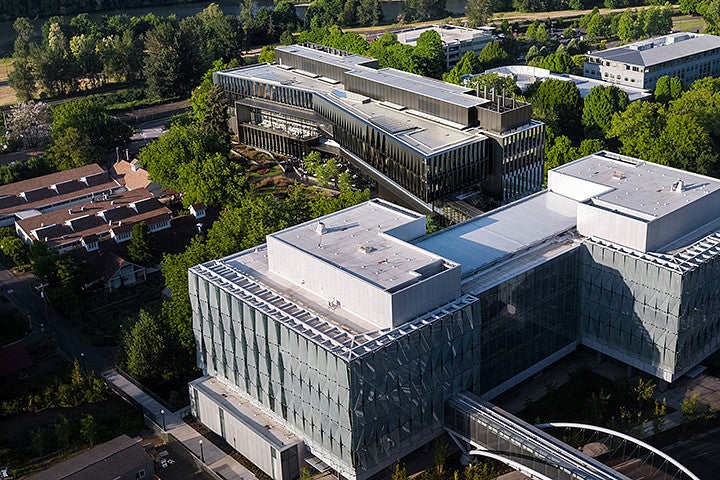
Building 2 is part of the second phase of Knight Campus development, a 185,000-square-foot, multi-story bioengineering and applied science research facility. Designed by Portland-based ZGF Architects, it will double the campus’ capacity for research and development of new biomedical technologies with additional room for expanding academic programs, spin spaces to incubate new startup companies and a state-of-the-art new BioFoundry core facility. It will include the second of two Papé Family Innovation Center facilities, offering individual modules that companies can lease, and providing flexibility for different kinds of startup companies.
Building 2 FAQ
When will Building 2 open to the UO Community?
- March 30, 2026
Is Building 2 open to the public?
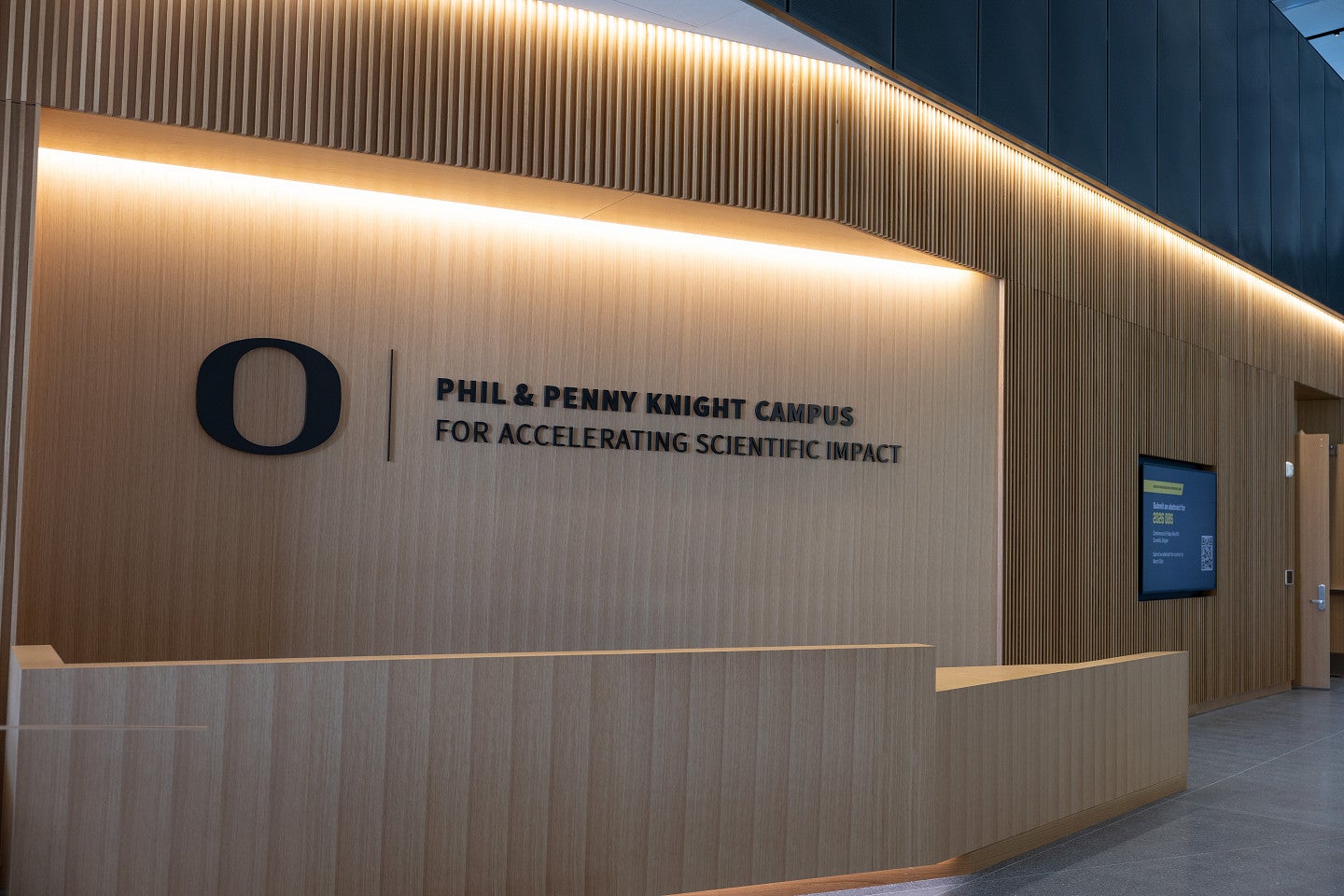
- Yes, public spaces on floors 1 and 2 of Building 2 are open to the UO community and the public during business hours (Monday-Friday, 7 a.m. to 5 p.m.). UO Dining’s Riverfront Bistro operate weekdays with fresh, modern and locally inspired offerings, including coffee. Visitors can request a self-guided tour brochure at the front desk.
I am a student, can I go into Knight Campus Building 2?
- Of course! As noted above, public spaces on floors 1 and 2 are open during business hours (Monday-Friday, 7 a.m. to 5 p.m.).
What kind of research happens in Knight Campus Building 2?
- The Knight Campus is home to several entities, including the Department of Bioengineering, where most of our research labs are based. We have researchers who are interested in developing new materials to help bone and muscle heal faster after injury, developing new medical device sensors, and developing brain computer interfaces that could help patients with neurodegenerative diseases. Building 2 has capacity to house 17-20 research labs when filled. Additionally, the Knight Campus Building 2 houses the BioFoundry, which is a core facility that researchers can use to grow and study cells and tissues.
Who designed and built Knight Campus Building 2?
- Knight Campus Building 2 was designed by ZGF Architects and built by Hoffman Construction.
Are there any plans for a Knight Campus Phase 3?
- Discussions about future Knight Campus activity and growth at the leadership level are at early stages with the primary focus currently on the operationalization of Building 2 and hiring faculty principal investigators (PIs) to grow bioengineering as envisioned in Phase 1 and 2.
How much did Knight Campus Building 2 cost?
- The budget cap for Knight Campus Building 2 was set at $330 million. The project is currently well within budget. The total cost won’t be determined until sometime after the building is open.
What is the long-term vision for the Knight Campus?
- To quote our Executive Director: Robert Guldberg, Vice President and Robert and Leona DeArmond Executive Director in our Annual Report: "UO is known for its iconoclastic innovation, from pioneering athletic performance to breakthrough technologies. The Knight Campus represents the next chapter in that story. We are fast becoming an irresistible destination for high-performing faculty and students — a flywheel for research, innovation and societal benefit — a center of excellence with global reach."
How does Building 2 further the overall mission of the Knight Campus?
- Students, postdocs, and faculty gain access to cutting-edge tools and technologies designed to meet the Knight Campus's mission of Science Advancing Society, and dramatically shorten the timeline between discovery and societal impact. “Building 2 will enable us to grow our critical mass of talent and encourage the convergence of science, technology, and people,” said Robert Guldberg, Vice President and Robert and Leona DeArmond Executive Director. “Building 2 puts the “Campus” in Knight Campus creating the space for engineering with an emphasis on meeting the needs of engineering students who will train there to become the biomedical innovators of tomorrow.”
How was Building 2 funded?
- Building 2 was funded primarily through the generosity of the Knight family, augmented by $10M in state funds to equip the shared facilities and other private philanthropic support.
How will STEM students directly benefit from Building 2?
- Building 2 includes instructional spaces designed specifically for engineering training, opening up providing academic opportunities for STEM students interested in engineering more broadly than current spaces allow. These instructional spaces are equipped with advanced tools — 3D printers, fume hoods, microscopes, and electrical engineering tools among other items. The spaces provide hands-on opportunities for students to learn best practices and cutting-edge techniques in bioengineering and applied sciences. Additionally, the student maker space is envisioned to be a hub for teaching, experimentation, and collaboration, where trainees at many levels can utilize advanced equipment for class and extra-curricular group projects.
How will the new building benefit students beyond bioengineering or STEM majors?
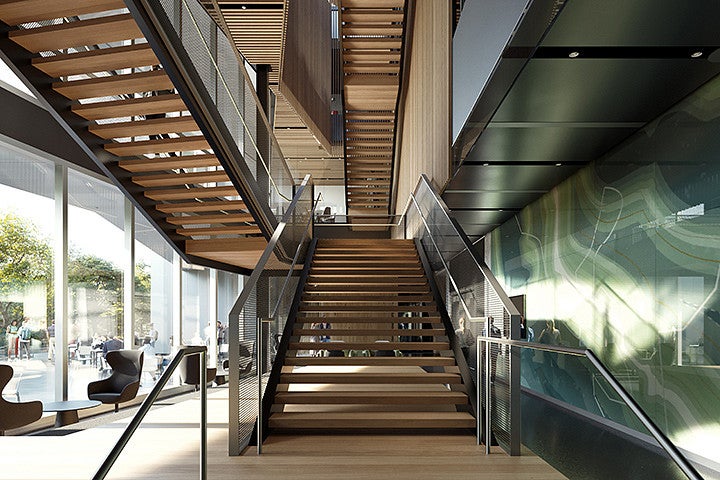
- The public spaces offer inside and outside locations for study, socializing, and dining in a stimulating environment. Comfortable seating areas, public art, and seating amidst native plantings are a few of the amenities available.
What is biomedical data science, and how does it fit into the mission of the Knight Campus?
- Biomedical data science involves the use of data, statistics, and computing to understand health and disease and improve medical research and patient care, and connects to our mission of Science Advancing Society by enabling the use of data to detect and treat diseases earlier, faster, and better. Building 2 will accommodate 17-20 research groups focusing on both bioengineering and biomedical data science and offers a computational suite which will house the Center for Biomedical Data Science (CBDS). CBDS is a joint research initiative through the University of Oregon (UO) and Oregon Health & Science University (OHSU), dedicated to using advanced data science to understand biological systems across all scales. Through integrating world-class expertise across the state of Oregon, CBDS aims to prevent and cure diseases earlier, faster, and better. The center is made possible by $20 million in lead gifts from Tim and Mary Boyle that was split between UO and OHSU.
How will Building 2 enhance research opportunities?
- A key highlight of Building 2 will be a core research facility, the Knight Campus BioFoundry, which will house advanced technology to support a wide variety of analytical techniques for studying cells and tissues. The Knight Campus BioFoundry will house high-powered microscopy equipment for fast imaging of tissue, advanced machinery including mechanical testers that enable researchers to probe physical features of cells and numerous other high-tech tools. A state-of-the-art space that reenvisions a shared approach to cell culture research by incorporating individual cell lockers that enable parallel workflows while preventing cross-contamination.
How do I gain access to the BioFoundry?
- Access is available to University of Oregon and external researchers like all shared facilities at the UO. For access, training requirements, pricing, or experimental support, please contact the BioFoundry team or visit the Knight Campus Core Facilities website, and the Nemo instructions page.
Building 2 Downloadable Images
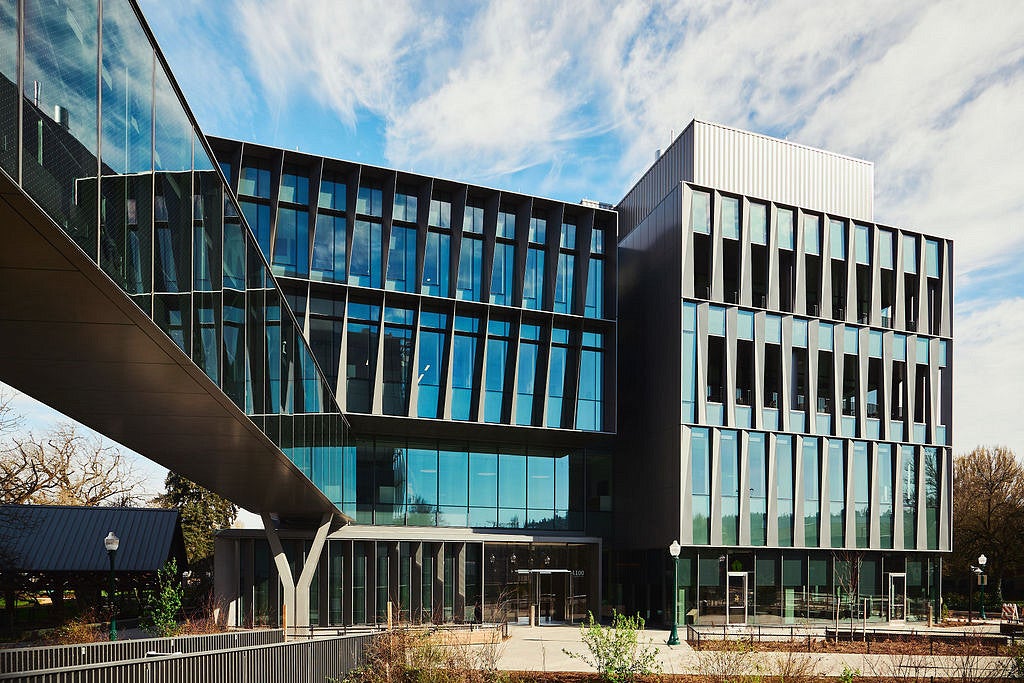
External Building 2, Photo credit: Photo courtesy of Hoffman Construction/Nine 84


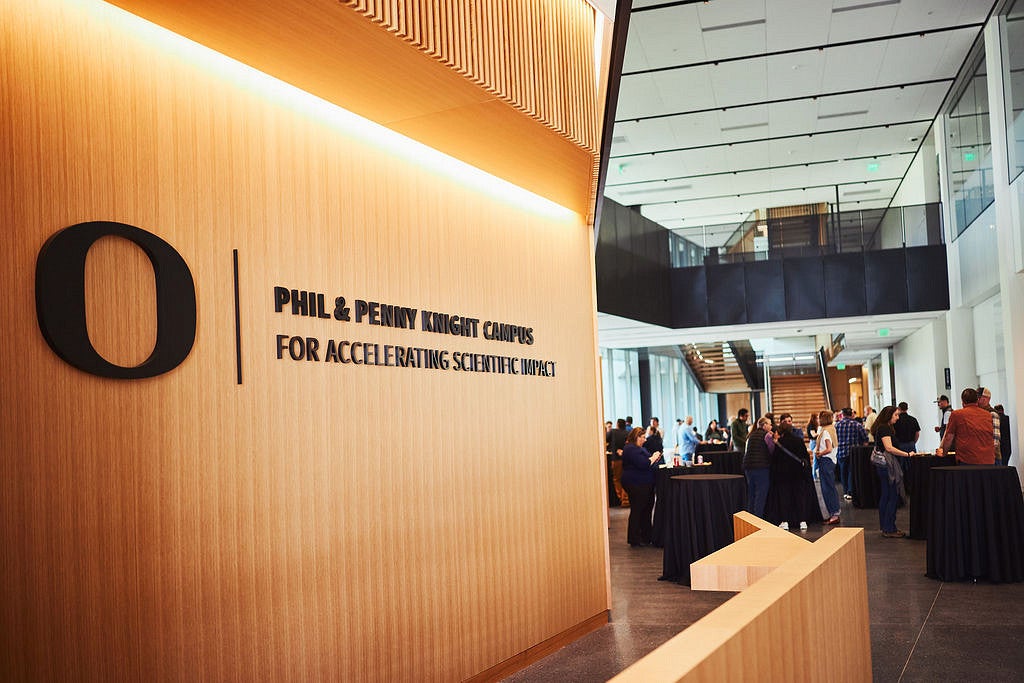
Internal Building 2, Photo credit: Photo courtesy of Hoffman Construction/Nine 84


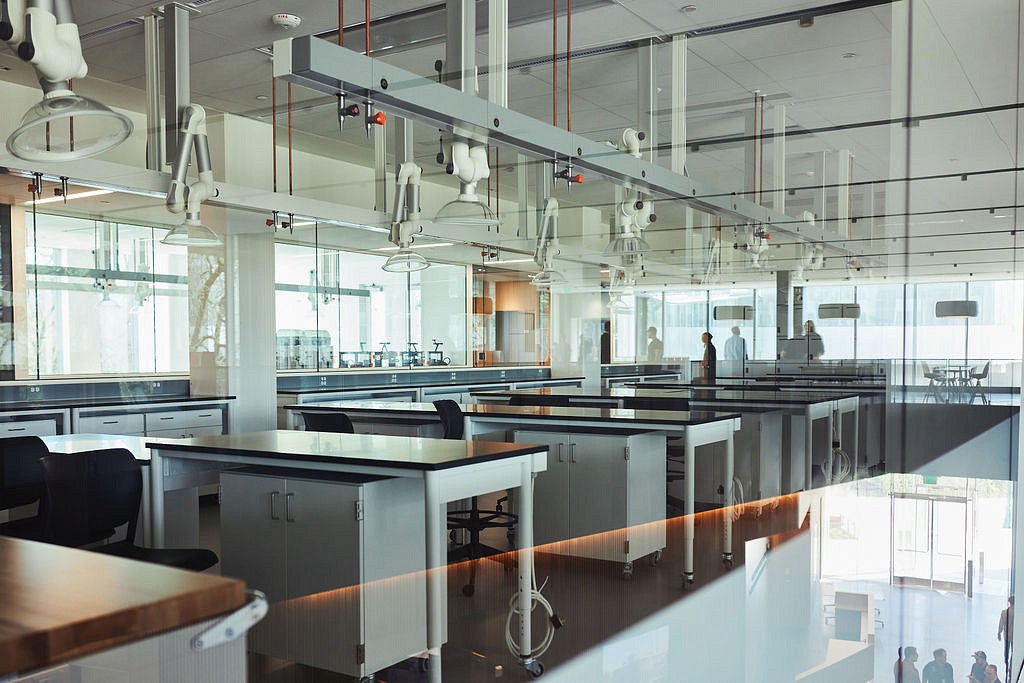
Internal Building 2, Photo credit: Photo courtesy of Hoffman Construction/Nine 84


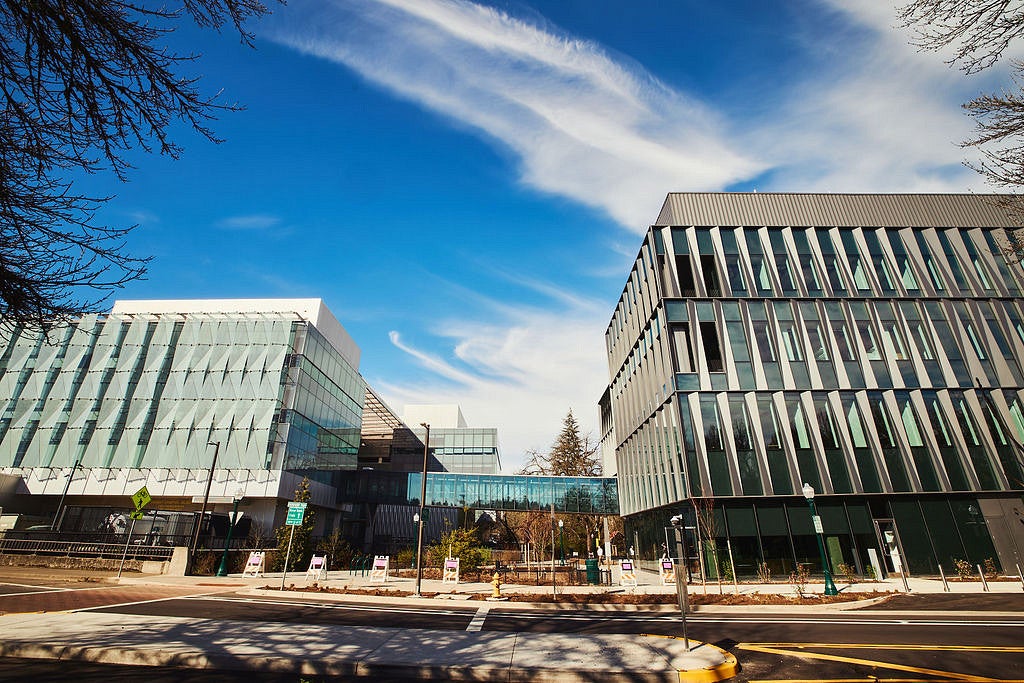
External Building 2, Photo credit: Photo courtesy of Hoffman Construction/Nine 84


References
Overview
The Phil and Penny Knight Campus for Accelerating Scientific Impact is the most dramatic change in the 140-year history of the University of Oregon. While it has unlimited potential for scientific education and societal benefits, its success is also nearly entirely dependent on continued donor, state, federal, and community support. It’s essential that our communications are consistent, accurate, clear, and aligned with the expectations of both current and prospective funders.To ensure this accuracy, all communications materials that reference the Knight Campus are required to be approved by University Communications. To streamline the approvals process, use the recommendations and resources provided in this style guide.
Clearing Your Project
If you’re planning to use Knight Campus assets for event-marketing, editorial or commercial purposes, or are a member of a partner organization creating informational materials, please seek approvals and permission.
- Seek approval for your project by writing to kccomms@uoregon.edu.
- Allow a week for approval of all documents, although many requests can be turned around more quickly
Editorial Guidelines
Academic and Professional Citations
Phil and Penny Knight Campus for Accelerating Scientific Impact, University of Oregon, Eugene, OR
References
Spell out the first reference to the Phil and Penny Knight Campus for Accelerating Scientific Impact. In subsequent references, use Knight Campus.
- First reference: The Phil and Penny Knight Campus for Accelerating Scientific Impact
- Additional references: Knight Campus
- Campus references: When referring to the entire campus, use Phil and Penny Knight Campus for Accelerating Scientific Impact or Knight Campus
- Building references:
First reference to the building at 1505 Franklin Blvd.: Phil and Penny Knight Campus for Accelerating Scientific Impact Building 1 or Knight Campus Building 1 (NOTE: "Building 1 of the Phil and Penny Knight Campus for Accelerating Scientific Impact or Building 1 of the Knight Campus are also acceptable)Additional references: Building 1 First reference to the building at 1100 Riverfront Parkway: Phil and Penny Knight Campus for Accelerating Scientific Impact Building 2 or Knight Campus Building 2 (NOTE: "Building 2 of the Phil and Penny Knight Campus for Accelerating Scientific Impact or Building 2 of the Knight Campus are also acceptable) Additional references: Building 2 Skybridges First reference to the skybridge connecting Knight Campus Building 1 to the Lewis Integrative Science Building: Phil and Penny Knight Campus for Accelerating Scientific Impact Skybridge or Knight Campus Skybridge Additional references: Skybridge First reference to the skybridge connecting Knight Campus Building 1 to Knight Campus Building 2: Phil and Penny Knight Campus for Accelerating Scientific Impact Skybridge 2 or Knight Campus Skybridge 2 Additional references: Skybridge 2
- General references: Use lower case for general references to the campus, the initiative, the project.
Avoid: Do not shorten Knight Campus to KC. (e.g., KC Building 1)
What It is Not
- A complex
- An institute
- A center
- A school or college
- An acronym, such as KCASI
Donor References
Penny and Phil Knight, BBA ’59Follow the naming protocol already in place for donors when referenced in an article or story:
- Penny and Phil Knight (when referring to a couple, use the woman’s name first)
- the Knights
- Mr. and Mrs. Knight
First names, Phil and Penny, are acceptable when used in direct quotes.
Funding
The new campus is made possible by an extraordinary $500 million lead gift from Penny and Phil Knight in 2016, augmented with $70 million in state bonds, and followed up with a second $500 million gift from Penny and Phil Knight in 2021.
Academic Department
The Knight Campus houses the Department of Bioengineering. In subsequent references, bioengineering or BioE are acceptable.
- First reference: Department of Bioengineering
- Additional references: BioE*, bioengineering
*Avoid the use of all caps (e.g., BIOE)
Descriptions
The Phil and Penny Knight Campus for Accelerating Scientific Impact is . . .
- 10-Word Description: . . . designed to accelerate the cycle of generating impact from discoveries.
- 25-Word Description: . . . designed to fast-track scientific discoveries into innovations, products, or cures to improve the quality of life for people in Oregon and throughout the world.
- 50-Word Description: . . . a new campus designed to accelerate the cycle of moving discoveries to impacts for the greater good. Rooted in the UO’s 60-year history of interdisciplinary collaboration, it will train new generations of scientists, forge tighter ties with industry and entrepreneurs, and create new opportunities for graduate and undergraduate students.
Social Media
The Phil and Penny Knight Campus for Accelerating Scientific Impact is on Instagram, LinkedIn, and Bluesky.
Hashtags — The following hashtags are primary
- #KnightCampus
- #KnightCampusBioE
- #AccelerateYourCareer
- #UOResearch
- #KCBuilding2Impact
Additional AccountsKnight Campus Graduate Internship Program
- Twitter (@UO_KCGradIntern)
- LinkedIn (https://www.linkedin.com/company/knight-campus-graduate-internship-program/)
- Instagram (@uo_kcgradintern)