
Optical Materials and Devices
Laser-Focused Training
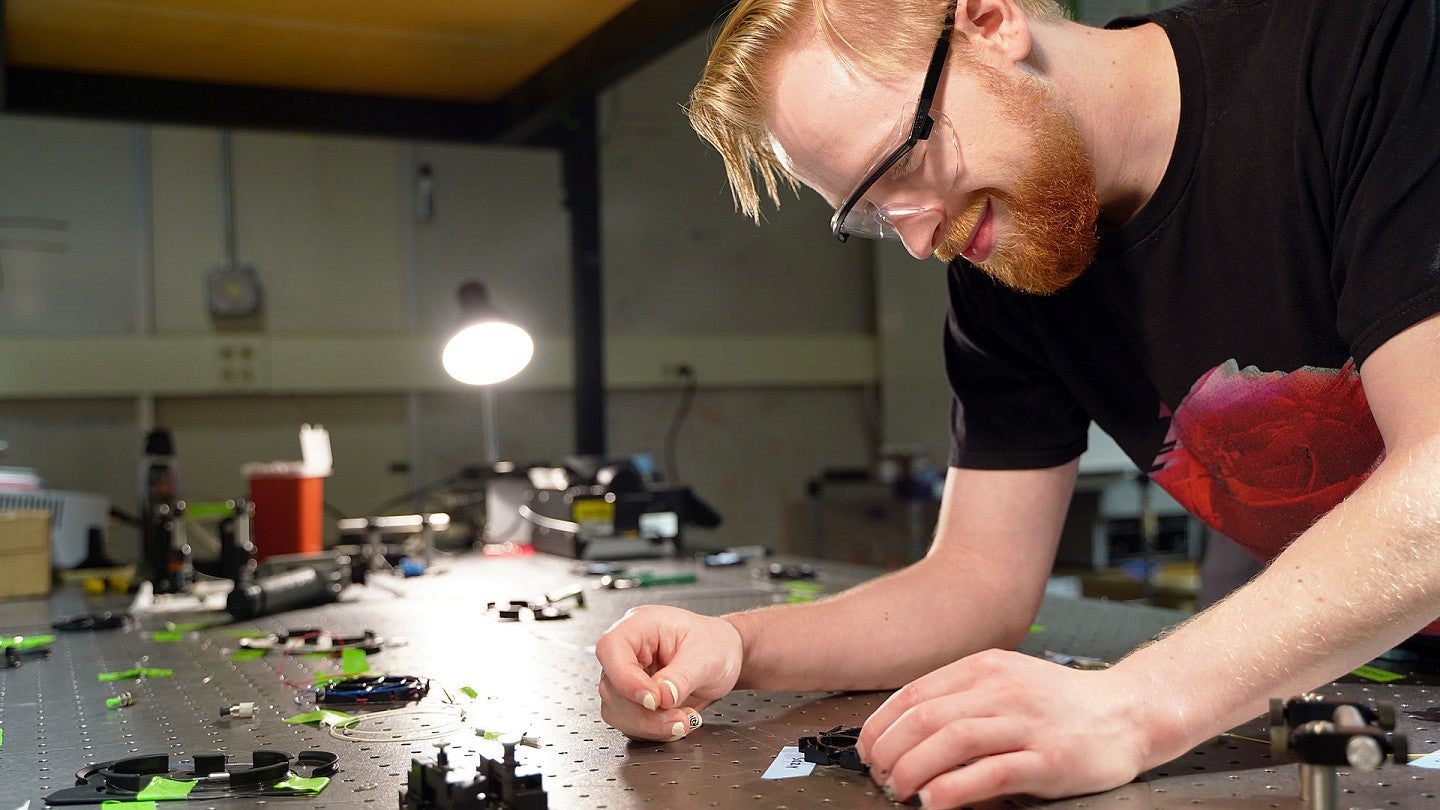
The optics program at the Knight Campus focuses on integrating technology, optical elements, fiber optics, optoelectronics, electronics and software programming to build state-of-the-art instruments for science research and advanced manufacturing.
Optical Materials and Devices
Laser-Focused Training
The optics program at the Knight Campus focuses on integrating technology, optical elements, fiber optics, optoelectronics, electronics and software programming to build state-of-the-art instruments for science research and advanced manufacturing.
What are optics?
Optics is the field of science that describes how light is generated, propagates through space, is modified and detected. Modern optics is a highly interdisciplinary practice that brings together physicists, chemists, computer scientists, optical, electrical and mechanical engineers. Scientists and engineers working in the field of optics use software to simulate and automate the experiments being conducted at an optics station. The physical optics space brings together mechanical hardware for alignment and stability purposes of the optical hardware, electronics act as the nervous system of the experiment, which acquires and analyzes the data with custom software packages.
Possible Career Paths
Students who complete the optics track work in a wide variety of engineering roles within the life science, semiconductor, and defense sectors, as well as peripheral sectors such as next-gen computing and autonomous vehicles. Alumni from this track develop skills which have been successfully transferred to a wide variety of engineering and management roles in manufacturing, hardware development, materials research, analytics, software development and research and development.
- Defense/aerospace
- Remote sensing
- Laser micromachining
- Fiber optics/telecommunications
- LiDAR for autonomous vehicles
- Biomedical device development
- Virtual and mixed reality (VR/AR)
- Advanced manufacturing
- Computational solutions
- Semiconductors
Example Positions and Job Titles
Optical Engineer / Optical Scientist / Photonics Engineer
- Design and build systems that integrate photonic, electronic, mechanical, and thermal components along with software
- Improve performance of optical instruments through hardware development and computational optimization
- Work on tools such as imaging systems, microscopes, and flow cytometers for scientific and clinical applications
- Apply optics to fields like biomedical research, pharmaceuticals, and advanced instrumentation
Laser Engineer / Laser Scientist / Photonics Systems Specialist
- Design, prototype, analyze, and optimize laser systems for performance and reliability
- Evaluate beam quality, power, and stability under demanding operating conditions
- Develop components that withstand extreme environments in high-energy laser systems
- Apply laser technologies in areas such as medical procedures, manufacturing, and precision instrumentation
Research and Development Scientist / Photonics R&D Engineer / Optical Systems Innovator
- Research, design, prototype, and test technologies based on optical and photonic principles
- Develop integrated systems combining lasers, detectors, and data acquisition tools
- Create novel solutions for applications such as remote sensing, agriculture, and autonomous systems
- Drive innovation across emerging technologies and multidisciplinary engineering fields
Course Sequence: Timeline
First 6 months: Coursework at the Knight Campus
Summer, Fall
Students complete core coursework and optional electives.
Students will attend information sessions with corporate and national labs to learn about opportunities, network, and interview with partners to line-up internships.
Second 9 months: Internship with External Partner
Winter, Spring, Summer
Students fulfill their internship requirement through employment with internship partners beginning in January and ending in September.
The majority of students complete their master's degree in 15 months.
To learn about how students fund the program, visit the Scholarships and Funding Opportunities page.
Curriculum at a Glance
Course schedule
SUMMER | FALL | WINTER | SPRING |
|---|---|---|---|
Physical Optics with Lab | Advanced Projects Lab | ||
SUMMER Year Two: Internship |
Full Course Descriptions
Optical Materials and devices
Course | Credits | Term | Instructors | Description |
|---|---|---|---|---|
| 4 | Summer | Ben McMorran, Eryn Cook | Students will learn how to derive theoretical descriptions of various optical components and systems from first principles. By building and optimizing optical systems (beam expanders, interferometers, optical cavities, isolators, etc.) using a host of optical components (mirrors, lenses, gratings, beam splitters, etc.), students learn how to control the flow of electromagnetic radiation through space. |
PHYS 627: Optical Materials and Devices and Physical Optics | 4 | Summer | Jens Noeckel, Eryn Cook | The second lecture & lab course covers the fundamental principles and practical operation of optoelectronic tools such as photodiodes, light emitting and laser diodes, digital cameras and numerous other devices commonly found in an optics laboratory. Theoretical topics are introduced in lecture covering the inner workings of these devices while time in lab is used to learn the proper handling, operation and characterization of optoelectronic devices that emit and detect light. |
PHYS 610: LASERs & Nonlinear Optics | 2 | Summer | Eryn Cook, Michaela Kleinert, Francesca Sansavini | This course introduces optical phenomena that require the laws of quantum mechanics and nonlinear dynamics. Students are introduced to the fundamentals of light and matter interactions with an emphasis on laser operating principles. Students will then study the physics and applications of nonlinear optics including a formal definition of the nonlinear susceptibility, which is related to the index of refraction. We will specifically look at applications to generate or modulate light. |
PHYS 610: Advanced Projects Lab | 4 | Fall | Bryan Boggs, Eryn Cook | In this final core course, students work in pairs to apply their recently gained knowledge on a five-week project. Students choose a project which allow them to deepen their experience in a field they have found interesting during the previous three courses. The advanced projects lab gives students a chance to work on open-ended projects that reflect the experiences commonly had by students during their internships. Examples of past projects include: the design and construction of a double-clad high-power continuous-wave fiber laser, Erbium-doped fiber amplifier, high-power ultrafast fiber laser, fiber dispersion characterization tools (modal and temporal dispersion), optical tweezers – and building various semiconductor optical metrology tools. |
CH 610: Professional Communication in Science | 1 | Summer | Stacey York | Students learn and apply foundational skills critical for career progression of scientists and engineers. Core elements include: composing a competitive resume; sharing impactful answers during behavioral and technical interviews; and building a strong professional network. |
PHYS 610: Optical Modeling with OpticsStudio | 4 | Fall | Kieran Lerch, Eryn Cook | Students will model and analyze optical systems in OpticStudio, a widely used software package in the optics industry. Topics covered include performance optimization, tolerancing and manufacturing, and accessing online resources. Through this course students will gain the ability to use OpticStudio to model commercial optical elements and systems as well as create and optimize novel optical systems. Students will be shown creative approaches to solving problems that they might ordinarily consider outside of the scope of their training. |
Electives: Physics or Related Discipline Graduate Level Electives | 8 | Fall | Varies | Students further specialize or broaden their knowledge through 8 credits of elective coursework (the equivalent of two UO courses). Popular electives include: Electron Microscopy, Introduction to Surface Analysis and Electron Probe Microanalysis. |
PHYS 601: Research Internship | 10 per term, 30 total | Winter, Spring, Summer | Jess Lohrman | Within an academic, clinical, industrial, or national lab setting, students gain hands-on experience in the application of their knowledge. Each term, students write a review paper to demonstrate advancement of technical knowledge and development of written communication skills. Learn more about the internship by visiting our Internships page. |
Ready to Start Your Journey?
Applications for Summer 2026 are now open. Join the Knight Campus Graduate Internship Program and transform your career.