
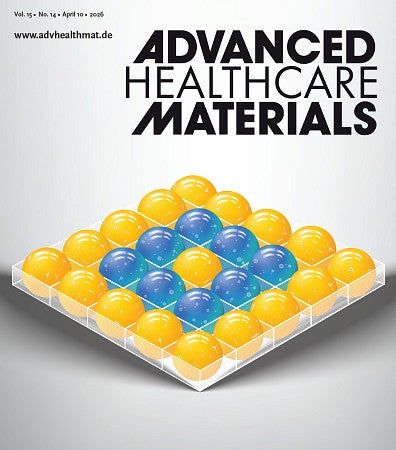
Growing living tissue in a lab requires more than just cells, researchers must consider all the nutrients they need, including oxygen. Without a steady supply of oxygen, cells in large, lab-engineered tissue can suffocate and die. In new research in the Journal of Advanced Healthcare Materials, the Lindberg Lab tries to overcome this hurdle. They started by creating tiny particles loaded with calcium peroxide, a compound that slowly breaks down to release oxygen over time; however, this process also produces hydrogen peroxide, which is toxic to cells. To get around this, the Lindberg Lab packed the oxygen-releasing particles and the living cells into separate microscopic spheres, then arranging them within a 3D-printed scaffold so that oxygen can diffuse to where it's needed without the harmful byproduct reaching the cells.
The cover art, created by Rachel Bedford of the Knight Campus Communications office in collaboration with the Lindberg Lab, visualizes this approach, where blue spheres carry the peroxide compound while yellow spheres carry the living cells, nestled together within the scaffold's mesh structure. This piece was selected for the back cover for Volume 15, Issue 14 of the Journal of Advanced Healthcare Materials.
You can see the art here: https://advanced.onlinelibrary.wiley.com/toc/21922659/2026/15/14
And read the original publication here: https://advanced.onlinelibrary.wiley.com/doi/10.1002/adhm.202503713