
The University of Oregon's Phil and Penny Knight Campus for Accelerating Scientific Impact is prominently featured in a new Oregon Historical Society exhibit marking 150 years of the University of Oregon, running through March at the Portland museum.
Titled “Unstoppable: 150 Years of the University of Oregon,” the exhibit is a celebration of the past and a blueprint for the future. Visitors can explore interactive displays related to wildfire prevention, important inventions, and the dynamic culture of UO. They’ll learn more about collaboration and scientific study over fifteen decades.
On October 16, 1876, the University of Oregon welcomed its first students, launching with just two paths of study. The UO now has 302 certificate and degree programs, campuses in Portland and Eugene and has become a leader in university alliances all over the globe. The exhibit celebrates the UO’s innovative impact, spanning challenges in children’s behavioral health, human performance, the environment and beyond.
The Knight Campus threads through much of the exhibit, including thin-film microelectrode arrays from the lab of Felix Deku, the Greg and Betsy Hatton Assistant Professor of Neuroengineering — flexible neural interfaces designed to help researchers better understand, and eventually treat, conditions such as epilepsy, Parkinson's disease and vision loss. Visitors will find replicas of implantable, 3D-printed particles developed in the lab of Robert Guldberg, vice president and executive director of the Knight Campus, engineered to sit at a fracture site and speed bone healing; the particles have already been tested in pre-clinical models.
The exhibit also turns, quite literally, to something that glows. A collaboration between bioengineer Paul Dalton and chemist Ramesh Jasti produced "nanohoops" — ring-shaped fluorescent molecules that Dalton's 3D-printing technique and Jasti's chemistry combined into implantable structures that shine under UV light. That glow gives researchers an easier way to track and monitor implants inside the body over time, with potential applications ranging from wound healing to artificial blood vessels and nerve regeneration.
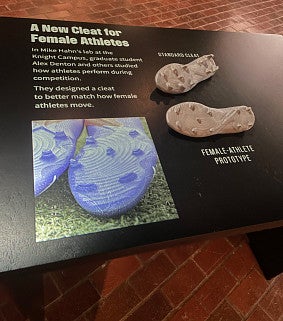
Not every display case holds a medical device. Other Knight Campus work is featured, including the Brewing Innovation minor, known as BRIN, where students in majors ranging from biology to history to business management learn the fundamentals of iterative innovation the old-fashioned way: by brewing. The stories behind the students’ innovative beers, along with their finished beer can label artwork sit alongside displays on the Wu Tsai Human Performance Alliance, a national research initiative with a hub at the University of Oregon that studies elite athletic performance to improve health and well-being more broadly.
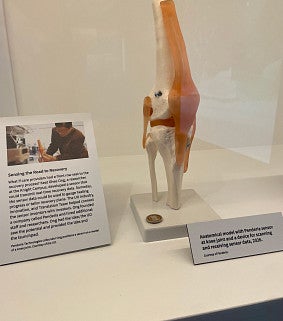
The exhibit showcases innovation in many forms, including the first startup company to spin out of Knight Campus, Penderia Technologies.. Co-founded by bioengineering professor Keat Ghee Ong and Guldberg, Penderia builds implantable wireless sensors that measure tension at surgical repair sites. Its Sensorized Soft Tissue Anchor System — aimed at procedures like ACL reconstruction and rotator cuff repair — recently received the FDA's Breakthrough Device Designation, a status meant to speed the technology's path toward clinical use.
The timing of the sesquicentennial and this fall’s celebration is particularly meaningful to the Knight Campus. On Oct. 16, 2016, 140 years to the day after the UO opened its doors, Phil and Penny Knight announced the $500 million gift that founded the Knight Campus. On Sept. 23 of this year, the Knights committed $1 billion to the University of Oregon to establish the Knight College of Engineering at the Knight Campus — the largest gift ever made to a comprehensive public university.
The Oregon Historical Society exhibit offers the opportunity to show how research underway today could help shape the university's next 150 years. It runs through March 29, 2027. For more information, visit the Oregon Historical Society website.