
50% of this year’s eligible cohort of first year PhD students received the NSF GRFP award, which will support their bioengineering research for three years.
Three grad students and one post-baccalaureate student affiliated with the Knight Campus Department of Bioengineering have been awarded prestigious Graduate Research Fellowships from the National Science Foundation. The NSF Graduate Research Fellowship Program (GRFP) is considered the gold standard in graduate research fellowships and is awarded to approximately 2,000 students nationwide each year.
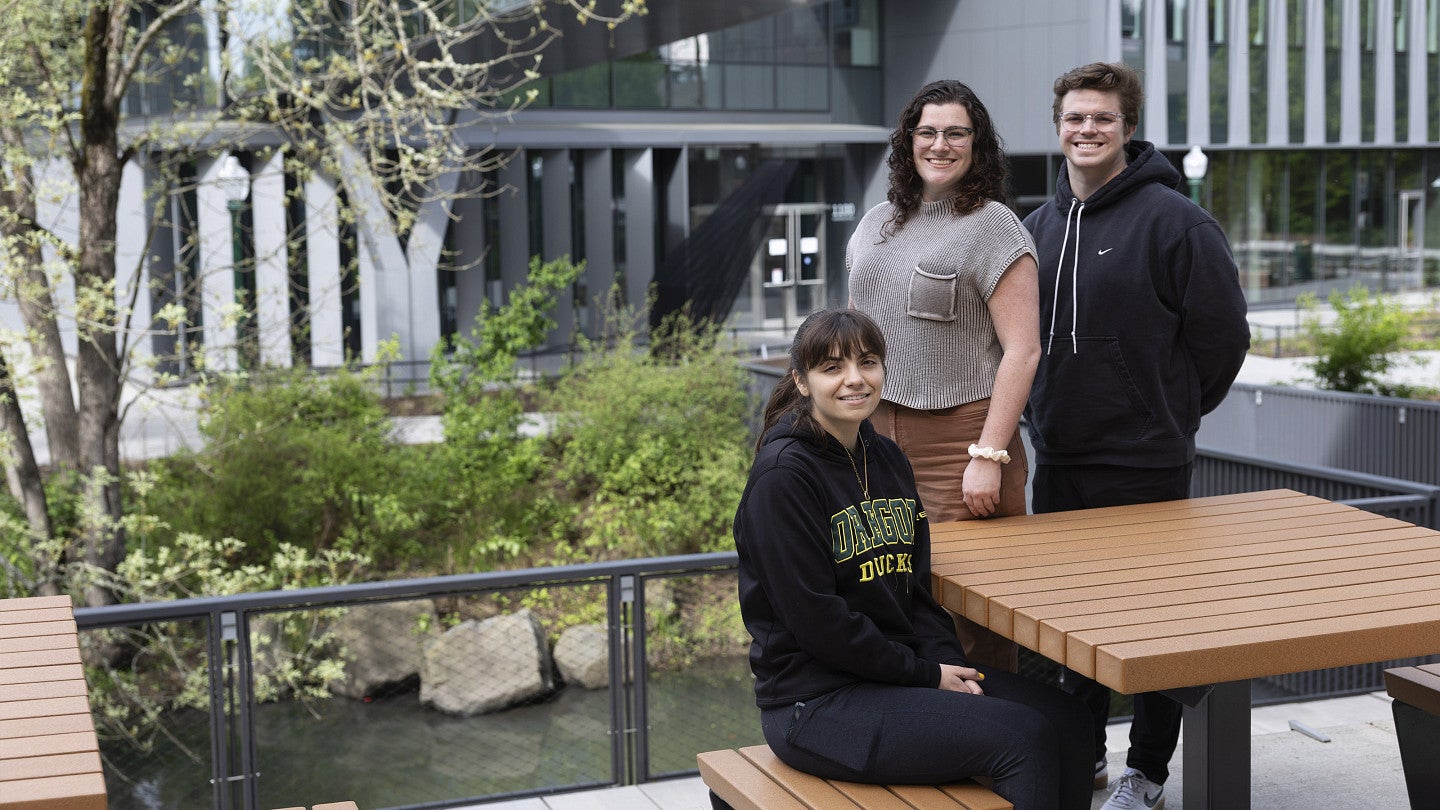
Fellowships went to Ph.D. students Kelsey Krusen, Emma Anderson and Max Tenenbaum. Additionally, Josh Kupfer, a Ph.D. student co-advised in the Guldberg and Dalton Labs, arrived at the Knight Campus with a GRFP already in hand, brings further distinction to this year's cohort. Annika Deans, a former undergraduate scholar in the Benoit Lab, and Miranda Simpson, a current post-bac in the Hosseinzadeh Lab also received a fellowship.
“This achievement reflects not only the hard work and talent of these outstanding students, but also the thoughtful mentorship of their advisors and the tireless dedication of the Knight Campus IMPACT Team and their continued commitment to student success,” said Danielle Benoit, Lorry Lokey Chair of the Department of Bioengineering.
Krusen credited the guidance she received from Benoit, her advisor, feedback from postdoctoral scholars in her lab and backing from the Knight Campus IMPACT Team, which provides workshops, training and intensive support to graduate students in applying for grants, fellowships and other awards, with helping her achieve success.
“Having people who are devoted to helping you no matter what … to bounce ideas off of, look things over and share their experience from having applied for so many grants and fellowships and opportunities and be supportive through the entire process and was a huge help for me,” Krusen said.
Advisors and support teams play an important role in the GRFP process. Krusen and Anderson are both advised by Benoit, and Tenenbaum is advised by neuroengineering professor Felix Deku. Tenenbaum credited his advisors for their support and emphasized what he described as a collaborative form of competitiveness that pushes researchers to put their best foot forward.
“We learned to not give up on big ideas,” Tenenbaum said. “Just because it’s difficult to articulate, doesn’t mean it’s a bad idea. Our advisors helped us get what we were thinking onto paper so that we could write something cohesive and comprehensive, and they put in a lot of time helping us to get this done.”
The Knight Campus IMPACT Team, which supports students through the fellowship application process, hosted student workshops featuring peer review sessions, breakout groups and guidance from previous year’s recipients.
Anderson said the IMPACT Team helped focus Knight Campus PhD student applications in time to meet an accelerated deadline after the National Science Foundation revamped the application process in mid-cycle. Students met with advisors during early morning workshops before classes with roughly a month to prepare and submit their proposals.
“All of us had lots of ideas for what kind of projects we wanted to do, but being able to help us organize the ideas and present them in a way that is exciting is something the IMPACT Team is, for sure, responsible for,” Anderson said.
“This is fantastic news for our students, said Nathan Jacobs, senior director of academic and IMPACT programming.” Seeing their dedication to science communication and proposal writing lead to such meaningful outcomes is incredibly rewarding for all of us.”
The GRFP recognizes and supports outstanding graduate students pursuing full-time research-based master's and doctoral degrees in science, technology, engineering, and mathematics (STEM). Each recipient will receive three years of financial support, including an annual stipend of $37,000.
Anderson is doing research in the Benoit Lab where she is working on delivering nanoparticles, small molecules that can deliver drugs throughout the body, to bone fracture sites in hopes to speed up regeneration and healing. Tenenbaum is doing research in the Deku Lab where he is developing and testing ways to grow brain organoids, lab grown neural structures, hoping to provide new tools to the neuroscience community and understand the patterns that occur as a brain develops. Krusen is also doing research in the Benoit Lab, where her work is focused on creating a muscular microphysiological system, an in-lab system that grows cells on microfluidic chips to mimic the physiological state in the body, to study both healthy and diseased human muscle tissue.
This year's awardees continue a tradition of GRFP excellence at the Knight Campus, with 50% of this year’s eligible applying cohort receiving an award. The Department of Bioengineering has now produced fellowship recipients every year since its founding, including five students recognized in 2024 — David Frey, Phillip Hernandez, Nicholas Pancheri, Iman von Briesen, and Malley Gautreaux — as well as Kaylee Meyers (2023) and Jarod Forer (2022) and Yan Carlos Pacheco, the program's first GRFP recipient, in 2021.
April 15, 2026