
Chasko Receives an F31 Fellowship
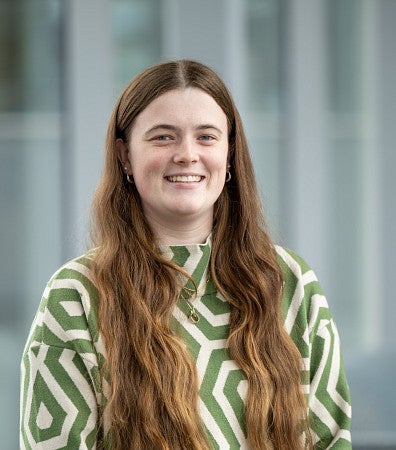
Bioengineering Ph.D. candidate DeShea Chasko has been awarded a competitive National Institutes of Health (NIH) Individual Predoctoral Fellowship (F31) to support her research creating 3D bioprinted bone marrow models.
This fellowship recognizes early-stage researchers whose work shows strong potential to advance scientific knowledge and benefit human health.
Chasko's research, conducted in the lab of Gabriella Lindberg, an assistant professor of bioengineering at the Phil and Penny Knight Campus for Accelerating Scientific Impact, focuses on building more accurate models of bone marrow.
For a successful bone marrow transplant, stem cells must move from the bone marrow to the blood for downstream clinical treatments. However, some patients, especially those 65 and older, have fewer stem cells moving out of the marrow and into the bloodstream. It is not entirely understood why this occurs, but Lindberg and Chasko speculate it occurs because as the body ages, physical parameters within tissues, like stiffness, can change and make it more difficult for cells to move.
Chasko hopes to address that by building models of the bone marrow in the lab, where different factors can be manipulated, to create representations of both young and old bone marrow systems.
"The central idea is that when we age, the physical properties of the bone marrow change, particularly its stiffness, which may limit stem cell movement," said Chasko. "However, current models do not accurately capture the different stiffness patterns that exist across populations, especially in 3D."
Chasko plans to build these 3D bone marrow models using hydrogels, soft structures that can provide support to cells and can be altered to be more or less stiff. This will allow her to isolate how stiffness influence stem cell movement and behavior.
Understanding how age-related stiffness influences stem cell movement within the bone marrow is important, as many patients who are in need of receiving bone marrow transplants for treatment of common blood cancers are over 65 years of age. The goal is that work like this could one day inform improved, personalized strategies for stem cell transplantation in patients with blood cancers, such as multiple myeloma, leukemia, and lymphoma.
"DeShea's work tackles a question that has real consequences for patients," said Lindberg. "By engineering bone marrow models that reflect the biology of human aging, she is giving us tools to understand why some transplants succeed and others don't — and how we might tip the odds in patients' favor."
-
April 23rd, 2026