
Bioinformatics and Genomics
Success Is in Our DNA
Jump start your career in this rapidly growing, high-demand field, by applying computer science and statistics to solve big-data problems in biology, biotechnology, and precision medicine. Harness the power of genomic data science to improve human health and facilitate biological discovery and innovation.
Bioinformatics and Genomics
Success Is in Our DNA
Jump start your career in this rapidly growing, high-demand field, by applying computer science and statistics to solve big-data problems in biology, biotechnology, and precision medicine. Harness the power of genomic data science to improve human health and facilitate biological discovery and innovation.
About the Program
Bioinformatics and Genomics is an interdisciplinary field blending biology, computer science, and statistics to manage, analyze, and interpret complex biological data — with applications spanning biotechnology, precision medicine, and genomic discovery. This accelerated master's program is designed to fast-track students from diverse scientific backgrounds into the field, offering 9 months of immersive, cohort-based training in algorithmic logic, statistical methods, and biological concepts, followed by a paid 9-month internship for real-world experience. By graduation, students will have practical skills, industry experience, and a professional network to launch a flexible, high-demand career in bioinformatics.
Possible Career Paths
Bioinformatics graduates typically move into data-driven roles across government, healthcare, academia, and industry R&D. Their training in analyzing biological data translates well into broader data science and analytics careers, with applications spanning medicine, agriculture, security, and predictive modeling.
- Drug discovery
- Cancer research
- Gut microbiome research
- Medical and clinical research
- Cell and gene therapies
- Agricultural and food science solutions
- National security and bio-surveillance
- Foundational scientific research
- Predictive modeling and data science

Example Positions and Job Titles
Bioinformatics Research Analyst / Bioinformatics Scientist / Programming Analyst
- Build, modify, and manage custom data analysis pipelines
- Perform statistical analyses and interpret biological data
- Collaborate with multidisciplinary teams to generate insights and visualizations
- Work on questions across: developmental biology, evolutionary biology, translational research
Data Scientist / Research Data Specialist
- Design and manage data systems for efficient storage and access
- Integrate multiple data types (e.g., omics + population data)
- Build predictive models and machine learning classifiers
- Example: Create models to distinguish tumor vs. non-tumor cells
Bioinformatics Software Engineer / Software Test Engineer / Programming Analyst
- Develop scalable, reproducible software for biological research and diagnostics
- Build and optimize pipelines without focusing deeply on biological interpretation
- Engineer tools for research, clinical diagnostics, or lab instrumentation
Student Projects
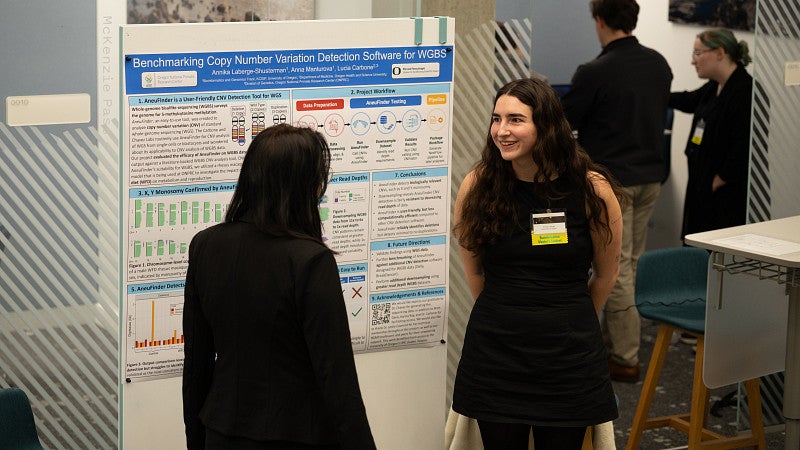
Imagine the possibilities. From single-cell RNA-seq to machine learning applications, explore the many opportunities to hone your skills and present your work.
Alumni
The Knight Campus Graduate Internship Program has a robust and active alumni community. Learn more about where our graduates go after this program and view alumni publications.
Bioinformatics and Genomics Faculty

Leslie Coonrod
Director, Bioinformatics Track
Jason Sydes
Senior Bioinformatician, Bioinformatics Track and Genomics and Cell Characterization Core Facility

Maxine Wren
Instructor, Bioinformatics Track
Lisa Bramer
Senior Data Scientist, Pacific Northwest National Lab

David Degnan
Biological Data Scientist, Pacific Northwest National Lab

Hope Healey
Instructor, Bioinformatics Track
Course Sequence: Timeline
First 9 months: Coursework at the Knight Campus
Summer - 12 required credits
Fall - 9 required credits
Winter - 9 required credits
Students complete core coursework and optional electives.
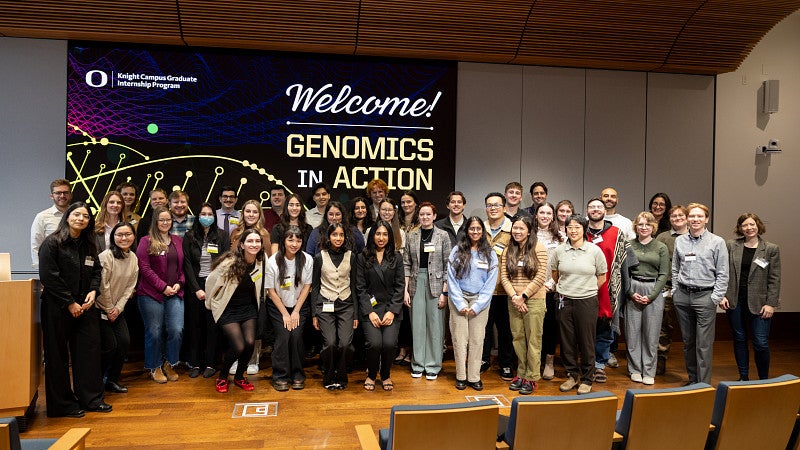
Students will attend a scientific meeting (Genomics in Action), present a poster, network, and interview with partners to line-up internships.
Second 9 months: Internship with External Partner
Spring, Summer, Fall - 10 credits each
Students fulfill their internship requirement through employment with internship partners beginning typically in April and ending in December.The majority of bioinformatics students complete their master’s degree in 18 months.
To learn about how students fund the program, visit the Scholarships and Funding Opportunities page.
Curriculum at a Glance
Course schedule
SUMMER | FALL | WINTER | SPRING |
|---|---|---|---|
Computational Methods in Genomic Analysis Genomics Techniques Topics in Genomics Analysis | Genomics Research Lab Advanced Biological Statistics for Omics Data Professional Communication in Science I | Advanced Genomics Analysis Machine Learning for Omics Data Professional Communication in Science II | Internship (most start on or after April 1) |
SUMMER Year Two: Internship | FALL Year Two: Internship |
|
Full Course Descriptions
Bioinformatics and Genomics
Course | Credits | Term | Instructors | Description |
|---|---|---|---|---|
BI 621: Computational Methods in Genomics Analysis | 4 | Summer | Leslie Coonrod, Jason Sydes, Maxine Wren, Hope Healey | Students learn to think algorithmically by writing scripts in Bash and Python. They manage and analyze next generation sequencing (NGS) data, navigate the UNIX command line, and utilize tools on both their computer and UO's high-performance computer cluster, Talapas. |
BI 622: Genomics Techniques | 4 | Summer | Maxine Wren, Leslie Coonrod, Jason Sydes, Hope Healey | Learn about experimental design, genomics history and technology, and the molecular techniques for preparing high-quality nucleic acid sequencing libraries for both short and long-read sequencing. This course also develops students' written and oral scientific communication skills. |
BI 623: Topics in Genomics Analysis | 4 | Summer | Hope Healey, Lisa Bramer, Leslie Coonrod, Maxine Wren | Students are introduced to wide-ranging topics including phylogenetics, comparative genomics, transcriptome assembly and assessment, metagenomics, RNA-seq preprocessing, alignment and enumeration, and differential gene expression analysis, as well as statistics used in these analyses. Write scripts to manage and visualize data using R/RStudio, create professional reports using R markdown, and continue honing Python scripting skills. |
BI 624: Genomics Research Lab | 4 | Fall | Leslie Coonrod, Jason Sydes, Maxine Wren, Hope Healey | Students write algorithms to analyze NGS data. Expanding upon topics covered in the summer, students are exposed to new topics in genomics analysis, including single-cell RNA-sequencing and statistical classification methods. Students begin team projects, in which they use real world data supplied by UO and external partner labs. This project continues through winter in BI 625. |
BI 610: Advanced Biological Statistics for Omics Data | 4 | Fall | Hope Healey, Lisa Bramer, David Degnan | This course will focus on fundamentals of applied statistical analysis for omics data. Students will gain an understanding of probability theory tenets such as sample spaces, basic and conditional probability, distributions, and Bayes' Theorem. Course material will focus on practical application of non-parametric and parametric statistical tests, regression, generalized linear models, and experimental design to biological data. Computing is done in R. |
BI 610: Professional Communication in Science I | 1 | Fall | Leslie Coonrod, Stacey York | Students learn best practices for professional scientific communication. Core elements include composing a competitive resume, providing impactful answers during behavioral and technical interviews, and building a strong professional network. Students prepare for internships through a variety of practical workshops. |
BI/CH/CS: Optional Elective | Varies | Fall & Winter | Varies | In fall and winter terms, students may take optional graduate level elective courses. Students should consult with program faculty when considering electives. |
BI 625: Advanced Genomics Analysis | 4 | Winter | Jason Sydes, Maxine Wren, Leslie Coonrod, Hope Healey | Students continue team projects from BI624 and design and present a poster during the track's annual scientific conference, Genomics in Action. They also gain exposure to special topics including object-oriented programming, SQL, analyzing PacBio data, custom figures using Python graphics libraries, and the use of containers and cloud computing. |
BI 610: Machine Learning for Omics Data | 4 | Winter | Hope Healey, Lisa Bramer, David Degnan | This course introduces core concepts and methods in modern multivariate data analysis and applications to omics data. Major topics include model selection, validation and bootstrapping, feature selection, and model assumptions for unsupervised and supervised statistical learning. Students apply models such as polynomial and logistic regression, discriminant analysis, elastic nets, tree-based methods, k-means, and hierarchical clustering to biological data. Computing is done in R and Python. |
BI 610: Professional Communication in Science II | 1 | Winter | Leslie Coonrod | Building upon fall term with a strong focus on job searches, preparing for interviews, and cover letter writing. |
BI 601: Research Internship | 10 per term, 30 total | Spring, Summer, Fall | Leslie Coonrod, Maxine Wren, Hope Healey | Within an academic, clinical, industrial, or national lab setting, students gain hands-on experience in the application of their knowledge. Each term, students write a review paper to demonstrate advancement of technical knowledge and development of written communication skills. Learn more about Internships. |
Ready to Start Your Journey?
Join the Knight Campus Graduate Internship Program and transform your career.