Bioengineering News

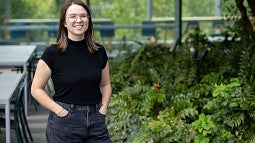
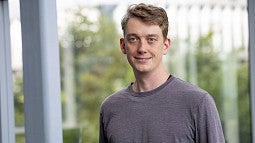
Colin Bredenberg recently began his work in the Knight Campus using artificial intelligence to understand learning and synaptic plasticity in the brain. His research sits at the intersection of artificial and biological intelligence.

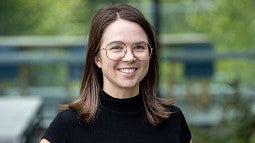
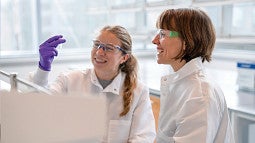
Zoé Christenson Wick recently opened her Knight Campus lab where she and her team are investigating how the timing of neural activity contributes to healthy brain function and build better therapies for epilepsy and age-related cognitive decline.

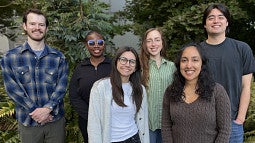
The Knight Campus Graduate Student Association (GSA) has announced its Executive Board for the 2026-2027 Academic Year.
In the Q&A, Christenson Wick describes her research, the lab culture she hopes to build, the best advice she got before opening her lab and other insights.

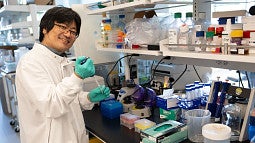
Researchers in the Ambati lab have received a $3.4 million grant from the National Institutes of Health to study the molecular origins of late-onset Fuchs endothelial corneal dystrophy.

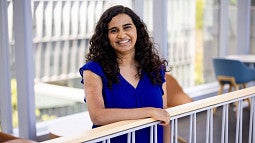
Marian Hettiaratchi received a $50,000 NSF I-Corps award to explore the commercial potential of a material developed in her lab.
Danielle Benoit received a $333,508 NIH award to study a targeted drug delivery approach for complex injuries that damage both muscle and bone.
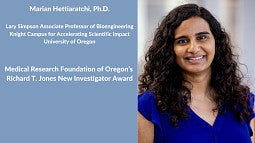
Marian Hettiaratchi, Lary Simpson Professor and Associate Professor in the Knight Campus Department of Bioengineering, will receive the Richard T. Jones New Investigator Award during an Oct. 1, 2026 ceremony at the OHSU Doernbecher Children’s Hospital
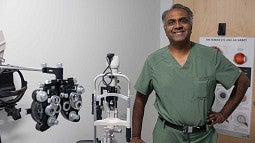
Knight Campus Research Professor Bala Ambati was profiled in the Aug. 27 edition of the Eugene Weekly. Among other things, Ambati discussed becoming a Guinness World Record holder for being the world’s youngest doctor, and his move to Eugene to pursue his research at the Knight Campus.

By engineering highly targeted molecules, called affibodies, and controlling when they release regenerative cues, researchers from the Marian Hettiaratchi Lab, are developing ways to help muscle, bone, and spinal cord injuries heal better and faster.